

A micro creator with 10,000 to 100,000 followers typically charges $250 to $1,500 for a sponsored Instagram post, $150 to $1,200 for a TikTok video, $200 to $1,500 for a YouTube integration and $200 to $800 for a post on X, according to 2026 benchmarks. The same creator can sit at the top or the bottom of those ranges depending on average views, niche, format, usage rights and exclusivity.
Follower count is the first filter brands use, so it is the right place to start. It is also the number that gets overvalued most often. This guide gives the 2026 ranges for each platform and tier, shows how the platforms compare with each other, and explains what moves a rate inside its tier.
How to read these benchmarks
The ranges below assume a standard sponsored deliverable: one post or video, organic publishing only, no paid usage window, no category exclusivity and a normal production timeline. Every source behind them describes its figures as estimates built from public data, not audited deal records, so treat them as planning ranges rather than a price list.
Within each tier, one simple rule holds across all platforms: a creator with 25,000 followers and 18,000 average views is selling far more reach than a creator with 25,000 followers and 2,000 average views. The tier gives the starting point. Average views for the exact format decide where in the range the rate lands.
Instagram influencer rates by follower count
The Instagram bands below come from Elev8or's Creator Rate Report 2026 and apply to one sponsored feed post from a creator in an average-demand niche such as lifestyle or entertainment.
| Followers | Sponsored post |
|---|---|
| 1,000-10,000 | $50-$250 |
| 10,000-100,000 | $250-$1,500 |
| 100,000-500,000 | $1,500-$5,000 |
| 500,000+ | $5,000-$12,000 |
Format changes these figures. Reels usually cost 20% to 100% more than a feed post because they can reach beyond existing followers, and a Story package usually costs 40% to 65% of a post. The two formats are covered separately in this guide to how much brands pay for Instagram Stories. For a quick check against your own account, the Instagram pricing calculator compares follower count, engagement and format.
TikTok influencer rates by follower count
TikTok is priced per video, and the production can be lighter than a polished Reel. The figures below are for one standard in-feed video of 15 to 60 seconds, based on InfluencerFee's 2026 TikTok rate breakdown.
| Followers | Sponsored video |
|---|---|
| 1,000-10,000 | $25-$200 |
| 10,000-100,000 | $150-$1,200 |
| 100,000-500,000 | $800-$6,000 |
| 500,000-1M | $4,000-$15,000 |
| 1M+ | $10,000-$150,000+ |
Two extras move a TikTok quote more than anything else. Spark Ads, where the brand promotes the creator's own post as an ad, usually add 15% to 30% to the fee. Long-form videos of one to three minutes price roughly double a standard clip. The TikTok pricing calculator gives a starting point from followers, views and engagement, and these TikTok engagement rate benchmarks show whether an account's engagement supports the top of its range.
YouTube sponsorship rates by subscriber count
YouTube costs more per deliverable because the production is heavier and the video keeps collecting views long after the campaign. These ranges are for one sponsored integration inside a regular video, based on 1of10's 2026 YouTube sponsorship benchmarks.
| Subscribers | Sponsored integration |
|---|---|
| 1,000-10,000 | $50-$500, often product plus fee |
| 10,000-50,000 | $200-$1,500 |
| 50,000-500,000 | $1,000-$10,000 |
| 500,000-1M | $5,000-$20,000 |
| 1M+ | $10,000-$100,000+ |
On YouTube, brands think in CPM more than in subscribers: a fee of $15 to $40 per 1,000 expected views is common for an integration in most niches, and dedicated videos cost two to three times more than an integration. The full breakdown is in this guide to how much brands pay for YouTube sponsorships.
X (Twitter) influencer rates by follower count
X is the cheapest major platform per post, and the most context-dependent. It works for B2B, tech, finance, crypto and founder-led brands where the creator has visible authority. InfluencerFee's 2026 X sponsorship rates give these ranges for one sponsored post:
| Followers | Single post | Thread |
|---|---|---|
| 5,000-25,000 | $50-$200 | $100-$350 |
| 25,000-100,000 | $200-$800 | $350-$1,400 |
| 100,000-500,000 | $800-$4,000 | $1,400-$7,000 |
| 500,000-2M | $4,000-$15,000 | $7,000-$25,000 |
| 2M+ | $15,000-$60,000+ | $25,000-$100,000+ |
A thread costs roughly 1.8 times a single post because it carries more of the brand's message and stays in the feed longer. On X more than anywhere else, replies, reposts and the quality of the conversation matter more than raw follower count, which is why creators in finance, crypto and AI sit at the top of each band.
Instagram vs TikTok vs YouTube: how the platforms compare
The clearest way to compare platforms is to hold the creator size constant. Elev8or's 2026 report indexes every platform against Instagram for the same micro creator in a lifestyle niche:
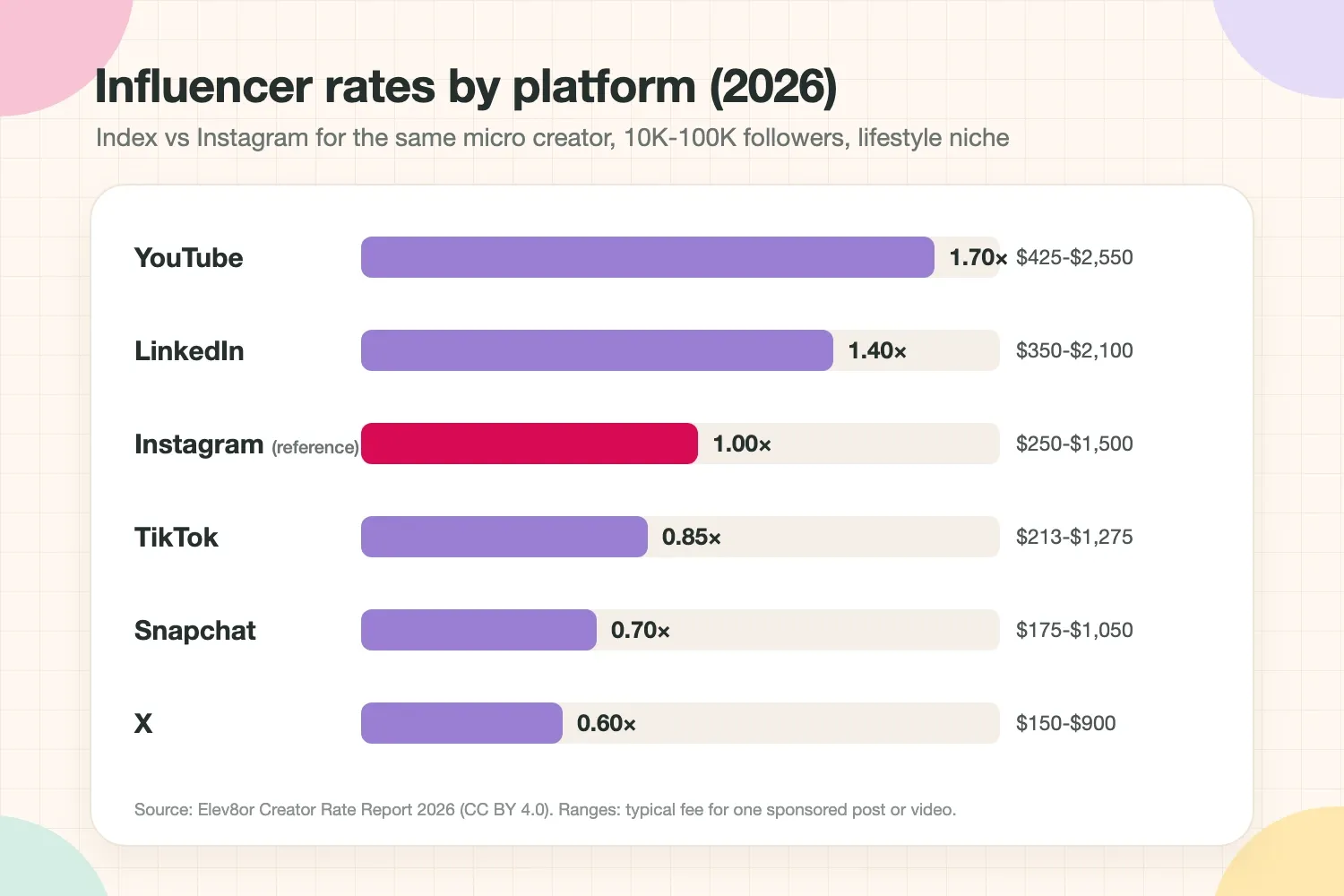
- YouTube: 1.7× Instagram. $425 to $2,550 for a micro creator. Heavier production, longer attention and long-tail views.
- LinkedIn: 1.4×. $350 to $2,100. A B2B audience with high purchase value.
- Instagram: 1× (reference). $250 to $1,500 for a feed post.
- TikTok: 0.85×. $213 to $1,275. Cheaper per video at the same follower count, because follower count predicts TikTok views poorly.
- Snapchat: 0.7×. $175 to $1,050.
- X: 0.6×. $150 to $900.
So at equal follower counts, TikTok typically costs 15% to 30% less than Instagram, and YouTube costs 50% to 100% more. That gap narrows fast for TikTok creators with consistent views: a creator with 30,000 followers who regularly lands on the For You page can charge more than one with 200,000 followers whose videos stall. This comparison of TikTok vs Instagram Reels for creator ROI looks at which format earns more for the same work.
Influencer rate per 1,000 followers
Many creators and brands still price per follower. Worked back from the Instagram bands above, a sponsored post comes to roughly:
- Nano (1,000-10,000): $25-$50 per 1,000 followers
- Micro (10,000-100,000): $15-$25 per 1,000 followers
- Mid-tier (100,000-500,000): $10-$15 per 1,000 followers
- Macro (500,000+): $10-$12 per 1,000 followers
The rate per follower falls as the account grows because reach does not scale with followers: a large account typically reaches a smaller share of its audience per post. The old rule of "$100 per 10,000 followers" is a floor for a nano or micro account, not a formula. A better one is CPM based: expected views × CPM ÷ 1,000, with a CPM of $10 to $30 for most Instagram and TikTok content and $15 to $40 for YouTube integrations.
Niche changes the rate more than most creators expect
Audience value changes the price at every tier. Elev8or's report applies a demand index to each niche, and the spread is wide:
- Tech and SaaS: 2.5× the lifestyle baseline. A micro creator quotes $625 to $3,750 instead of $250 to $1,500.
- Finance: 2.2×. Crypto: 2×.
- Luxury, real estate and e-commerce: 1.8-1.9×.
- Education, gaming, parenting: 1.4-1.6×.
- Fitness, health, wellness, home: 1.3×.
- Beauty, fashion, travel, skincare: 1.2×.
- Food, pets, books, DIY: 1.1×.
- Lifestyle, comedy, entertainment: 1× (baseline).
A finance creator with 20,000 followers is not overpriced at $1,000 per post. A comedy creator with the same audience usually is.
The pricing formula that works
The cleanest way to build an influencer rate is to start from the tier and platform, then adjust for everything the brand adds to the scope.
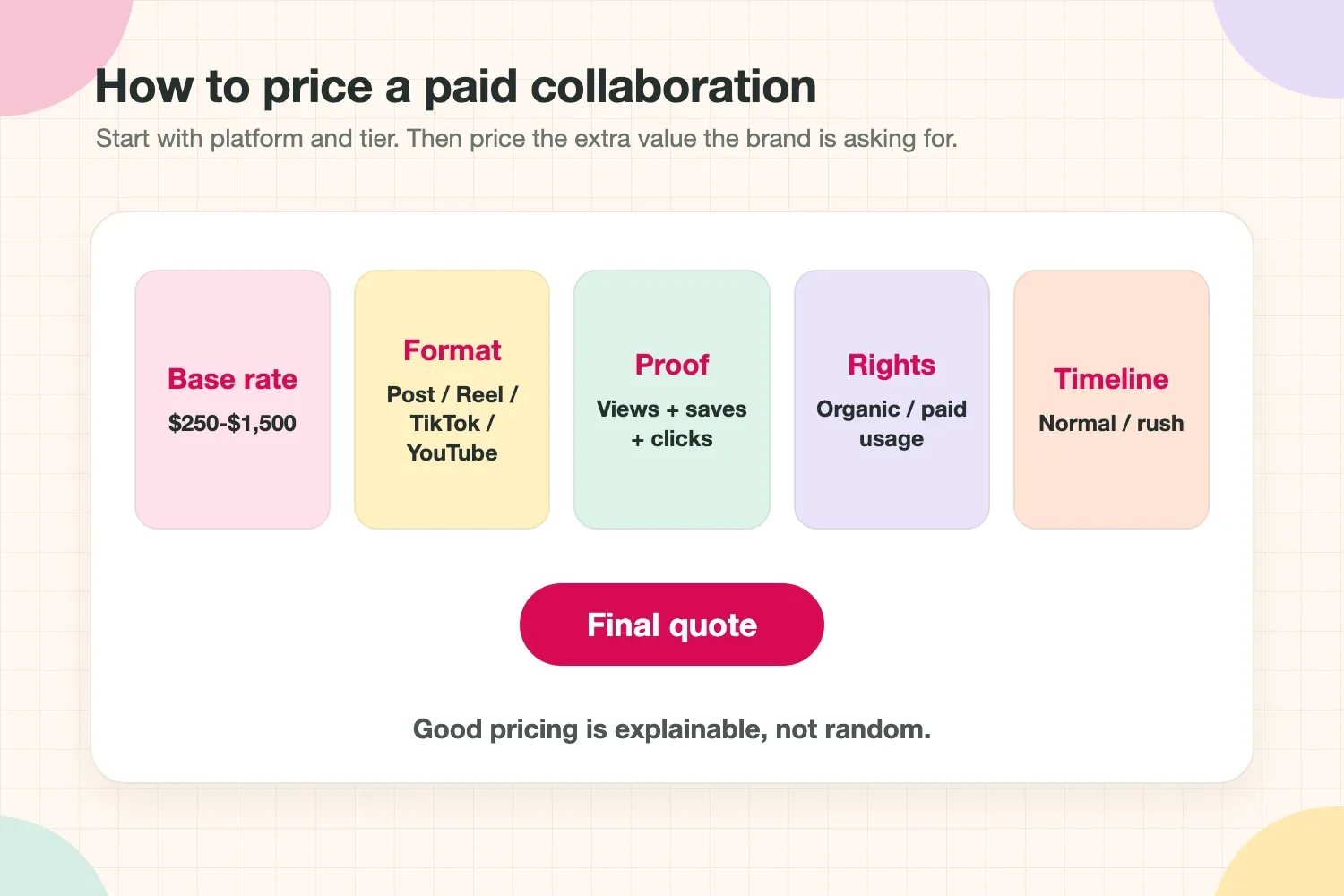
- Start with the platform and follower tier from the tables above.
- Place yourself in the range using average views for the exact format.
- Adjust for niche, audience quality and past campaign proof.
- Add separate fees for usage rights, whitelisting, exclusivity, extra revisions or rush timelines.
- Send the final quote with the deliverables written out.
For example, a lifestyle creator with 40,000 Instagram followers and solid Reel views might set $600 as the base for one Reel. If the brand wants 30 days of paid usage, the quote might become $800. One month of category exclusivity moves it higher again. The number is easier to defend when the creator can explain what changed.
What moves the final rate
Two creators with the same follower count can charge very different rates. That is normal, because the final price depends on the campaign structure.
Usage rights are one of the biggest rate movers. If a brand wants to reuse the content on its own channels or run it as a paid ad, the creator is no longer selling a post but licensing creative work. Paid usage typically adds 20% to 50% depending on the window and the channels. This guide on how to respond when a brand asks for usage rights explains how to price it.
Exclusivity also matters. If a beauty creator cannot work with other skincare brands for 30, 60 or 90 days, the brand is blocking future income, so the rate should reflect it.
Production quality changes the price too. A talking-head TikTok filmed in an hour is not the same as a fully edited Reel with product shots, voiceover, captions and reshoots.
Timeline matters when a brand needs content quickly. Rush work means moving other work and shooting under pressure.
Proof is the final layer. Creators with past results, clean reporting and brand examples can price near the top of their range because they are not asking the brand to guess.
Average rates by format
Follower count gives a tier, but format usually decides the workload.
- Instagram Reel: discovery and product education. Usually higher than a static post because production is heavier.
- Instagram Story: clicks, replies and launches. Priced as a package of frames, often with a link sticker.
- TikTok video: native short-form reach. Usage rights and Spark Ads can matter as much as the post itself.
- YouTube integration: deeper attention and long-tail views. Priced from CPM, topic fit and production work.
- X post or thread: authority and conversation. Best for accounts with visible expertise.
How creators should present their rates
A rate should not arrive as a lone number in a DM. It should read like a small proposal that includes:
- The deliverables included in the price
- The platform and format
- The expected timeline
- Whether usage rights are included or billed separately
- Whether exclusivity is included or billed separately
- Package options if the brand wants more than one asset
- A short reason the rate fits the audience and content quality
A creator can simply write that the quoted rate includes one Reel, one revision round, organic posting only and no paid usage. If the brand wants to run the Reel as an ad, that is scoped as an extra fee. Clear scope protects both sides: the brand knows what it is buying, and the creator avoids turning one sponsored post into five unpaid extras. A clean influencer media kit makes that context easy for a brand to review, and this guide to influencer rate negotiation covers what to do when the brand pushes back.
How brands should use influencer rate benchmarks
Brands should use these rates to plan budgets, not to force every creator into the same box.
A fair budget starts with the campaign goal. For awareness, reach and audience fit matter most. For content to run as ads, usage rights and production quality matter more. For conversions, link clicks, landing page fit and offer quality matter as much as the creator.
Brands should also avoid comparing creators by follower count alone. A creator with a smaller audience but better comments, better niche fit and cleaner reporting often creates more value than a larger creator with weak audience alignment.
For disclosure, paid collaborations should follow the relevant advertising rules. The FTC disclosure guidance for social media influencers is the reference for campaigns targeting U.S. audiences.
Common mistakes with influencer rates
The biggest creator mistake is underpricing because the brand says the campaign is "simple." Simple for the brand does not mean simple for the creator. Filming, editing, revisions, captions, approvals, reporting and usage rights all take time or carry value.
Another mistake is sending one flat rate without asking what the brand needs. A $500 Reel becomes a bad deal if it quietly includes paid usage, multiple revisions, exclusivity and a rush deadline.
Brands make mistakes too. The most common is asking for a rate before sharing the scope. Creators cannot price without knowing the deliverables, timeline, usage rights, exclusivity and campaign goal. Define the scope first, then discuss the rate.
Final thoughts
Influencer rates in 2026 run from about $50 for a nano creator's Instagram post to five figures for a large YouTube channel, with TikTok typically 15% to 30% below Instagram and YouTube well above it at the same audience size. Those ranges are benchmarks that start the pricing conversation, not fixed prices.
Follower count still matters, but it should not carry the whole quote. The best pricing decisions look at platform, format, average views, niche, audience quality, campaign scope, usage rights, exclusivity and proof. When both sides treat pricing as scope plus value, the conversation gets much easier.